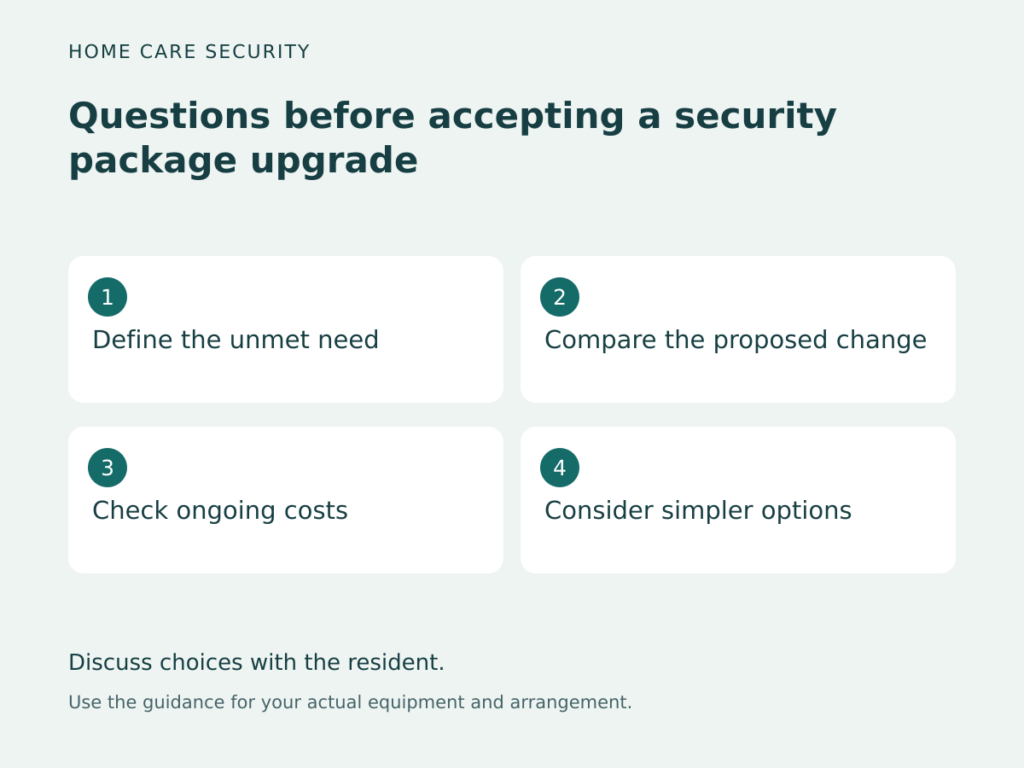
Home security package upgrade questions should begin with the task your current arrangement does not meet. More cameras, more accounts or more features are not automatically a better fit for the person living in the home. A useful proposal explains what would change and why.
Before discussing a larger package, ask the resident what is working well and what they would like to be different. Keep those answers beside the quotation so the decision stays connected to a real need.
Write down the unmet need
Use a concrete example rather than a broad worry. “I cannot see where callers wait beside the side door” gives the installer something to assess. “We need the best system” does not explain the task, the location or what would count as an improvement.
Separate a new requirement from a fault or a question about using existing equipment. A function that no longer works may need support. A confusing control may need another demonstration. Neither automatically establishes a need for a larger package.
- What task is difficult or unavailable?
- Is it a new need or a change in something that previously worked?
- Who wants the change and how does the resident feel about it?
- What should remain exactly as it is?
- What question needs answering before any purchase decision?
Our package comparison can help frame the options, but the actual equipment and terms belong in the quotation.
Ask how each proposed item helps
Read the proposal one item at a time. For each additional camera, viewing device or support option, ask which stated need it addresses. An item may be useful, optional or unrelated to the current priority. Keep those distinctions visible.
A fictional household wants help checking one entrance but is offered several additional views. The useful question is not simply whether the larger package costs more. It is whether those views serve an agreed purpose and whether a narrower arrangement could meet the need.
Do not infer performance from a product label or a longer feature list. Ask for an explanation tied to the exact equipment and property. If a survey or compatibility check is still needed, treat the answer as provisional.
Compare simpler alternatives
Ask whether guidance, an agreed adjustment or a different way of using an existing supported feature could address the task. The answer may still be an equipment change, but it should not be assumed before the current arrangement is understood.
For example, difficulty finding a recording may call for a playback demonstration rather than another camera. However, a guide cannot diagnose the installation from that symptom alone. Describe the task to the provider and ask what assessment is needed.
Keep the resident's preferences in the comparison. A technically capable option that adds controls they do not want may not be the most useful answer. Our family guidance explains why the person living at home should remain involved.
Review changes to access and privacy
An upgrade can change more than the number of devices. Ask whether it introduces new views, recording arrangements, notifications or people with access. Discuss those changes explicitly rather than treating them as incidental extras.
Record areas the resident wants to keep private and permissions that should not expand. Any new account access needs its own agreed purpose and supported setup. A larger package is not permission for relatives to watch more of the home.
If new camera positions could capture neighbouring or communal spaces, seek current privacy guidance and appropriate advice before agreeing the view. Do not assume that a feature described as a privacy control removes every responsibility.
Compare the total arrangement
Ask for the equipment, installation work, making good, setup and handover to be described clearly. Then separate one-off charges from any ongoing storage, subscription, maintenance or support costs. Record the provider and terms for each element.
Also ask what happens to the existing equipment. Will it remain in use, be removed or need a separate data-handling process? Do not dispose of a recorder or wipe an account merely because a replacement has been proposed.
Our guide to camera costs and support provides the detailed ownership questions. Avoid comparing only the initial price when the arrangements differ.
Use a keep change and question list
Before deciding, write three short lists. “Keep” covers useful features and boundaries. “Change” describes the requested improvement. “Questions” contains anything the proposal has not answered. This gives the resident a clearer decision than a comparison based solely on package names.
If the discussion changes the proposal, request an updated written version. A later decision should refer to the current equipment and scope, not an earlier quote plus several informal promises.
A decision example without a sales assumption
A fictional household is considering more cameras because a relative finds the current app confusing. Its “keep” list includes a useful front-door view and the resident's existing access boundaries. Its “change” list says the relative needs to understand the one task they have agreed to help with.
Before discussing extra equipment, the household asks for a demonstration of that task. If the issue is resolved, it can decide whether any proposed upgrade still has a purpose. If the equipment genuinely cannot support the wanted task, it can ask for a specific alternative and its limitations.
This example does not mean guidance will solve every problem or that an upgrade is unnecessary. It shows how to identify the reason for a purchase before comparing products.
When the answer is still uncertain, ask what information would settle it: a property assessment, a compatibility check, a demonstration or clarification of a charge. Keep the decision open until that information is available, rather than treating uncertainty itself as a reason to choose the largest package.
Considering a change? Contact Home Care Security with the task you want to improve and the equipment details you already have. Ask about suitable options without assuming an upgrade is necessary.